
Give peas a chance by Michael Rumbelow

With the pea season almost upon us, and many children, parents, and teachers looking for a break from screens, I would like to highlight the potential topical relevance of Friedrich Froebel’s peas work, or ‘sticks united by peas’, which I came across recently in “A Practical Guide to the English Kindergarten” written by Bertha Ronge in 1854. Ronge studied under Froebel, the inventor of kindergarten (or ‘infant gardens’), before moving to Britain and opening the first English-speaking kindergartens, in Tavistock Place, London, in 1851, and a few years later in Manchester and Leeds.

For Froebel, brought up in a small village in the Thuringian forest in Germany and originally an apprentice forester, communing with nature was at the heart of education. He went on to become an assistant to a professor of crystallography in Berlin, which led to an epiphany:

The stones in my hand and under my eyes became forms of life which spoke a language I understood. The world of crystals clearly proclaimed the structure of man’s life to me and spoke of the real life of his world. (Froebel 1967, p.39)

This revelation made sense of the child’s love of playing with building blocks:

in his [sic] own development he follows the course of Nature and imitates her [sic] modes of creation in his games. He likes to build and to imitate the structuring of form which we find in Nature’s first activity, in the formation of crystals. (p.38)

Wooden building blocks became central to Froebel’s set of six ‘Gifts’ to support children’s play in kindergarten, spawning a legacy of blocks as toys which continues in Lego, Minecraft and Roblox today. Famously several key 20th century architects, including Le Corbusier, Buckminster Fuller and Frank Lloyd Wright were brought up with Froebel’s blocks and acknowledged their influence on their designs and so, arguably, much of the modern built environment.

As children grow older and more dextrous Froebel also recommended ‘occupations’ – crafts such as weaving, painting, paper-folding and ‘peas work’, which involved building crystalline and other structures by using peas to join the points of thin wooden sticks, similar to cocktail sticks. Buckminster Fuller – famous for designing geodesic domes – recounted his experience at a Froebelian kindergarten in New England around 1900:

One of my first days at kindergarten the teacher brought us some toothpicks and semi-dried peas, and told us to make structures. With my bad sight, I was used to seeing only bulks. I had no feeling at all about structural lines. The other children, who had good eyes, were familiar with houses and barns. Because I couldn’t see, I naturally had recourse to my other senses. When the teacher told us to make structures, I tried to make something that would work. Pushing and then pulling, I found that the triangle held its shape when nothing else did. The other children made rectangular structures that seemed to stand up because the peas held them in shape. The teacher called all the other teachers in primary school to take a look at this triangular structure. I remember being surprised that they were surprised. (Quoted in Brosterman p.84)

In a curious loop back to crystals, when researchers discovered polyhedral structures of carbon atoms in the 1980s they named them ‘fullerenes’ after Buckminster Fuller’s architectural designs.

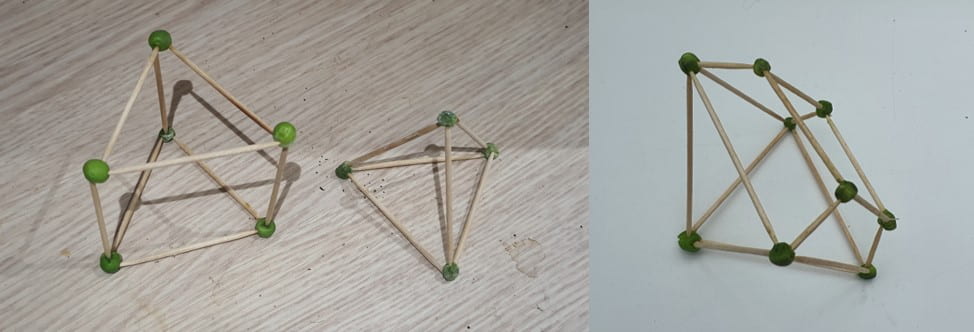
During lockdown I attempted some peas work with my 10-year old niece who I was bubbled with (results pictured below). Apart from their biodegradability, and the fact you can eat any left over, one satisfying aspect of peas is that they set hard overnight giving the structures some permanence. The main tip I would pass on is that garden peas – fresh, soaked from dry, or defrosted from frozen – are better than petit pois, or tinned marrowfat peas, which both tended to disintegrate on being pierced. Sweetcorn, hard berries and other veg would probably also be suitable, or whatever is in season outside.
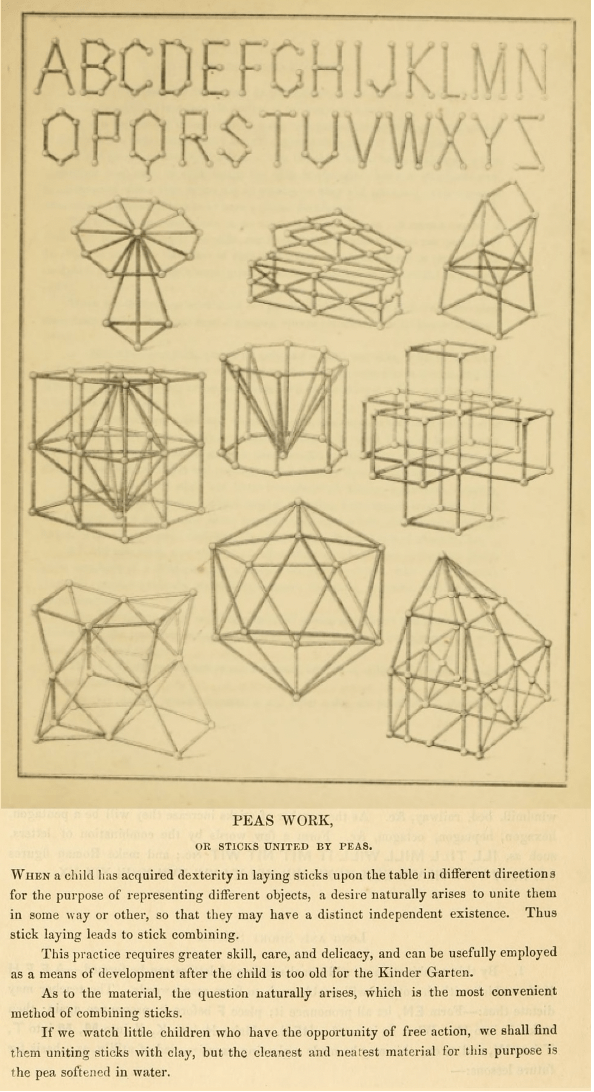
Having struggled to read some Froebel in English translation, for me Bertha Ronge’s book was a better contemporary introduction to his ideas. Clearly a labour of love, it is written in beautifully crisp Victorian English, with painstakingly hand-drawn illustrations – complete with endearing mistakes (see eg the alphabet in the picture, top) – and some unexpectedly fresh-sounding insights on the psychology of child development, such as babies’ attachment to caregivers, years before Freud was born. It also communicates a philosophical relationship with nature which seems to resonate with 21st century new materialists such as Jane Bennett, who in Vibrant Matter (2010) echoes Froebel’s sentiment on sensing life in objects in her environment she previously thought of as inert: “I caught a glimpse of an energetic vitality inside each of these things, things that I generally conceived as inert” (p.5).

Recently I was glad to notice some teachers keeping the tradition alive on Twitter, at #SticksAndPeas.


Bennett, J. (2010). Vibrant matter: A political ecology of things. Duke University Press.

Brosterman, N. (1997). Inventing kindergarten. Harry N. Abrams, Inc.

Froebel, F. (1967) in Lilley, I. M. Friedrich Froebel: A selection from his writings. Cambridge University Press.

Ronge, J., & Ronge, B. (1854). A practical guide to the English Kindergarten.


Blogpost written by Michael Rumbelow

COVID-19, education and the immediate policy response by Victoria Bowen

On 12th March 2020, the World Health Organisation declared the coronavirus disease 2019 (COVID-19) outbreak to be a pandemic.  What followed this announcement was to become the largest global disruption to education in history.  1.6 billion learners in 190 countries were affected, as nations implemented regional lockdowns and school closures to curtail the spread of COVID-19 (UN, 2020).  Since then, as the virus circulated widely in society across the globe, school closures have been implemented nationally, regionally, locally, and reactively based on infection rates.  This article follows on from my presentation on ‘COVID-19, school closures and inequality’ at the TLC roundtable event (March 2021).  It summarises the immediate education policy response relating to COVID-19 in English schools.

In England, national school closures were announced by the government on 23rd March 2020 with the stated aim of ‘reducing transmission of coronavirus (COVID-19), to protect the NHS and save lives’ (Gov.UK).  Legislation enacted on 25th March 2020 in the form of the Coronavirus Act 2020, further strengthened national powers to shut educational institutions to almost all pupils.  Children of critical workers were encouraged to attend school, as were vulnerable children, including those who are looked-after, have an education, health and care (EHC) plan and those who have been identified as being vulnerable and who could therefore benefit from continued full-time attendance (Gov.UK). While there is an acknowledgement that school attendance data has been inconsistently reported since March 2020, the headline figures for 17th April 2020 showed that while 61 per cent of schools were open only 0.9 per cent of pupils were attending at this time (Gov.UK).

From 1st June 2020, primary schools welcomed back pupils in reception, year 1 and year 6, alongside the priority groups outlined above, and from 15th June it was expected that secondary schools would also offer some face-to-face support for pupils in year 10 and year 12.  However, by the 18th June 2020 only 34 per cent of year 6 pupils and 10 per cent of year 10 pupils were attending; and by just before the summer holidays this number had only increased modestly to 44 per cent and 14 per cent respectively (Gov.UK).  These figures highlight the potential disadvantage to those not attending, especially as at this time there was no requirement for schools to offer online learning.

By the end of August 2020, it was the government’s view that ‘the prevalence of coronavirus (COVID-19) has decreased, our NHS Test and Trace system is up and running and we are clear about the measures that need to be in place to create safer environments within schools’ (Gov.UK).  This meant that all pupils, in all year groups, returned to school full-time from the beginning of the Autumn term 2020.


‘Returning to school is vital for children’s education and for their wellbeing. Time out of school is detrimental for children’s cognitive and academic development, particularly for disadvantaged children. This impact can affect both current levels of learning and children’s future ability to learn therefore we need to ensure all pupils can return to school sooner rather than later’.

(Gov.UK)


However, on 10th September 2020, only 92 per cent of state schools in England had fully reopened and attendance nationally was 88 per cent.  By the end of October 2020 attendance had fallen further to only 86.2 per cent, with 55 per cent of secondary schools and 20 per cent of primary schools reporting pupils absent through self-isolating.  By the end of the Autumn term in December 2020, attendance was only 85.5 per cent, with 63 per cent of secondary and 22 per cent of primary schools now reporting pupils absent through self-isolating (Source: Gov.UK). This reduction in school attendance coincided with an alarming increase in COVID-19 rates nationally, stoked by the emergence of a new more contagious variant.  So, from 5th January 2021, the decision was made to once again close all schools in England.  However in this second wave of school closures some schools welcomed increased amounts of children considered ‘vulnerable’ as they used their ability to identify those children who would ‘benefit from continued full-time attendance’ including ‘those who may have difficulty engaging with remote education at home (for example due to a lack of devices or quiet space to study)’ or those ‘who need to attend to receive support or manage risks to their mental health’ (Gov.UK).  By the end of January 2021, attendance in primary school was 22 per cent, but just 5 per cent in secondary schools.

The data summarised in the article calls into question provision for our most vulnerable children, especially at a secondary level.  It particularly highlights the potential impact of pupil absences as schools reopen.  Indeed, missing school due to absence is typically associated with substantially greater negative effects, and these effects are greater for disadvantaged children.  Sharp et al. (NFER, 2020) found, that of those pupils who were able to return in June, senior leaders reported only 56 per cent did, and that this fell to 45 per cent for Pupil Premium pupils.  This highlights a strong relationship between income, and willingness to return to school, which could further exacerbate inequalities, risking a situation where the children who are most able to cope with home learning return to school, leaving their more disadvantaged peers at home.


Post written by Victoria Bowen, PhD Researcher in Education, University of Bristol.